Thursday, February 11, 2016


Hello fans of The Cullowhee Community Garden! It has been way too long since our last blog post, almost two years, so what better use of a cold day in February than to update this blog!
We have a lot to share since our last post, and the thing that I am most excited about from last year is that we hosted 440 volunteers during our twice-a-week workdays! It is our members, and our volunteers that make this project possible. To all of you, I say Thank You
 
Another exciting development last year was the installation of NCDOT road signs that direct visitors and volunteers to the garden. I think that they look beautiful.
Other highlights from last season include the Cullowhee Volunteer Fire Department delivering water for our tanks when our pump system stopped working. They took time out from their schedule to bring water to us, twice. Thank you!


In 2015, we had the honor of working with Brave Sir Media in producing a promotional video for The Cullowhee Community Garden that involved some very cool and beautiful aerial drone photography. The video can be viewed on our Facebook page at www.facebook.com/CullowheeCommunityGarden or online at https://vimeo.com/141723001

At the height of our 2015 season, we had 36 garden plots adopted, both full and half sized. General attrition and life circumstances has reduced that number as we begin the 2016 season. We have plenty of room for anyone who would like to adopt a plot. Our plot adoption process for 2016 will begin very soon, so stay tuned for further information.

2016 will also feature the return of our monthly educational workshops. Our first offering will be a Fruit Tree Pruning Workshop on Saturday February 20th at 1 pm. Attendees will learn proper pruning and training techniques to maintain tree health, promote good shape and to increase fruit production for a variety of different fruit trees. This will be a “hands-on” workshop with the opportunity to put into practice what you have learned.

We will continue to offer educational programs every month, featuring topics such as Gardening 101; Soils and Composting; Pests, Weeds and Disease; Seed Saving; Fall/Winter Gardening; and others. If you have any suggestions for an educational topic, please let us know.

We will also continue our twice-a-week volunteer workdays every Saturday morning from 9 am until noon, and every Wednesday currently running from 3 pm until dusk. Start times for the Wednesday Workdays will be adjusted seasonally as the days get longer. And, of course, all workdays are weather dependent. If you have a group that would like to get involved at another time, please let us know.

For further information about how you can get involved in The Cullowhee Community Garden, please do not hesitate to contact the Garden Manager at adambigelow@jacksonnc.org or you can link with us on Facebook. Or, stop by the garden during one of our regular workdays, we would love to meet you.

Happy Gardening Everyone, and Kale Yeah!

Friday, April 11, 2014


Hello Gardeners and Supporters of The Cullowhee Community Garden! Happy planting to you all! We are excited to announce our new series of Monthly Educational Workshops in The Cullowhee Community Garden! 
We have decided to offer a seasonally relevant beginning gardener series, starting on April 19th starting at 1:00 pm, during our regular Saturday workday.

Our first offering will be Beginning Gardening 101,waking up the garden! We will cover topics such as: Soil, the foundation of all gardening; Starting Seeds, direct seeding vs transplanting; Annual and Perennial Weed Maintenance—the good, the bad, and the delicious; fertilizing; mulches; and much more. Please bring any questions you may have!

In May we cover Compost making and applications, and we dig deeper into the soil (ahem!). June will introduce gardeners to the ideas of Companion Planting and Succession Planting, both through the season and through the years. We will also cover Beneficial Flowers and Plants, including plants that attract beneficial insects, trap crops, and farm-scaping. In July join us to learn about Insects, both Pests and Beneficials. We will also cover Disease Prevention and treatment options. In August join us to learn about starting your Fall/Winter Garden and using Season Extension techniques such as mini-hoops and row covers. September will be time to learn about saving seeds. And we will wrap it up in October by Putting The Garden To Bed, and Maintaining The Winter Garden

We are continuing our twice-weekly Community Workdays in the Cullowhee Community Garden on Saturdays from 10 am until 2 pm, and on Wednesdays now starting at 4:00 pm and going until dusk. These workdays are a great time to get an introduction to the garden, meet other volunteers and gardeners, and to help with tasks outside of individual garden plots.

We look forward to seeing everyone around the garden this spring. The garden is coming to life, and is very beautiful this time of year. None of this would be possible without all of your hard work and support. Thank You All!

Thursday, March 13, 2014

Happy Springtime Everyone!

There may still be cold and snow on our horizon, as well as  in the garden this morning, but the plants and the soil know that it is springtime. And so do we here in The Cullowhee Community Garden!  

Wow, we sure have been busy since that last blog post on this site. Apologies for not keeping you all updated more. We have planted many of our fruit trees in the style of a 

Food Forest along the western edge of the garden area. 


We completed and planted our blueberry mounds along our main pathway. 

We have been removing invasive plant species, we cleaned out the beautiful black willow tree (Salix nigra) next to the shed, 


and have landscaped around it 


and throughout the garden with native shrubs and wildflowers that were donated to us by the plant vendors from the 2013 Cullowhee Native Plants Conference.


We have formed our planning committee, and held the first meeting of the year. The committee is using the consensus-based decision making process. You can read more about that here: www.consensusdecisionmaking.org

Currently our Community Volunteer Workdays are on Wednesdays from 3 pm until dusk, and every Saturday from 10 am until 2 pm. Common tasks include planting, weeding, spreading mulch, helping us with small infrastructure projects, and much more. Also, look for educational programs that we will begin offering in conjunction with the NC Cooperative Extension Service. We will keep you posted on that.

Please share with us suggestions and ideas for educational topics that you would like to see offered in The Cullowhee Community Garden, or if you would like to present on a topic that you know a lot about. You can also suggest other knowledgeable members of our community who you think could offer a great workshop for us.


We would love to have you come visit with us! The garden is always open, and always beautiful! Please, stop on by anytime! Until then, enjoy these videos of the garden.
Kale Yeah!

Thursday, April 4, 2013

Hello and Happy Spring!  The time is almost upon us, and we couldn't be more excited about beginning the first season of the Cullohwee Community Garden!  Our target for the first round of plot adoptions is the end of April, or beginning of May. We hope to be up and running in time for summer planting (our frost-free date is May 15th), and we hope to offer the plots with enough time to prepare your garden for planting.  Lots to do between then and now. If you are interested in helping in some of the work, please email me at bigelownc@gmail.com for information. As soon as we have a parking area ready, we can start holding volunteer workdays. We will be sure to let you know when that is. We are also planning an administrative workday to go through email lists, work up spreadsheets and other garden templates.  If you have skills and talents in the area of administration, we could really use your help. Please contact me for more information.  We will be going through all of the contacts that we have made in the past year, and inviting everyone to get involved. Everyone has gifts, talents and something to give; and, everyone is hungry for something. I learned this from Susan Sides of The Lord's Acre (thelordsacre.org) recently, and believe in it wholeheartedly.  The Cullowhee Community Garden can help feed that hunger in many ways, and will help you to share your talents with the community, whatever they may be.  Please feel free to email me if you want more information, or want to volunteer. Please put Cullowhee Community Garden in the subject line, so I know who you are.  You can also request a plot adoption form. It is time, and we couldn't be more excited!

Friday, January 4, 2013

Hello Friends of The Cullowhee Community Garden, and Happy New Year to you all!  2013 is going to be a great year for gardening in Jackson County. I am happy to announce that we have received our funding, and that the money did not fall down any cliffs, or get diverted to be used in funding Hydraulic Fracturing efforts in NC, but it is here and we get to grow The Cullowhee Community Garden!  It has been a long few months waiting for word on our funding, and it is a huge relief to have it finally come through!

We will update you all very soon on the new time-frame for the first round of plot adoptions, and any and all volunteer opportunities including helping to remove rocks and large sticks or roots from the garden area prior to tilling in the Spring.  There will also be opportunities for removing exotic-invasive plants from the property, and helping to build the infrastructure for the garden, including water catchment and pumping, fencing, compost making areas, spreading topsoil, and many, many other tasks necessary for implementing the garden.

We are very excited about The Cullowhee Community Garden, and hope that you are as well.  Hope to see you all, very soon!  The Cullowhee Community Garden...KALE YEAH!!!

Tuesday, September 18, 2012


Hello Gardeners,

And, a Great Big Thank You for everyone who has sent in donations to help us get this garden going. We have no idea when the grant funds will be released by the State, but we are confident that they will eventually release it. However, we don’t want to wait any longer. So, I am releasing the plot adoption contract, and the garden rules and expectations here on The Cullowhee Community Garden Blog.

Yes! The adoption process is now open and plots will be made available as soon as we are able to acquire some basic tools, equipment and supplies. The full budgetary procurement will follow once the grant funds are in our account.

For an application to join The Cullowhee Community Garden, please email me at bigelownc@gmail.com and I will send a copy of the application, along with some other documents. You can then send the completed application back to me via email, or you can print it, fill it out and send it to me at: Cullowhee Community Garden C/O Adam Bigelow 284 Keener St Sylva, NC 28779

Again, there is no fee for adopting a plot in our garden. Gardeners will agree to donate approximately half of their produce to The Community Table of Sylva, as well as to other organizations or people in need. Our aim is to provide space, tools, materials and assistance to members of our community while providing fresh, local, organic produce to our neighbors in need and to the organizations that serve them.  Truly, a win-win for everyone.

Gardeners will need to provide their own seeds, plants or starts for their own plots. However, often we in the Sylva Community Garden are blessed by donations of plant starts, seeds, and perennial plants from this great community that we live in. In the future, we will be growing some of our own plant starts, and a saving/collecting seed from our and other’s gardens. Locally adapted seeds, heirlooms passed down through families, and open-pollinated seeds will perform the best in our gardens. As we grow from year to year, we may be able to have our own collection of local seeds with local genetic provenance and adaptations.

While the window is slowly closing on being able to get in a Fall garden, there is still time to grow lettuces, winter greens like kale and collards, plant garlic, and to prepare your beds for overwintering and Spring planting. But, the window is closing, so lets not wait.

Please email me with any questions or concerns, and get your applications in as soon as you can. Thank You again to all that have donated to The Cullowhee Community Garden, and please feel free to send in monetary donations along with your applications. We need all the help that we can get, and appreciate it greatly!

LET'S GET GROWING!

Tuesday, September 11, 2012


Hello Gardeners and Supporters of The Cullowhee Community Garden. Well, we hit the ground running, and have completed a whole bunch of the preliminary work to get the garden up and running. All documents and forms have been created, the land has been cleared (twice!), the soil has been turned (and is Beautiful! Loamy Goodness and Rich!), and we have seeded out a cover crop blend consisting of annual grains, clover, winter pea, and others. However, we have hit a bit of a slowdown because the State has yet to release our funds. So, we are unable to make any purchases of necessary materials and equipment. Unless, that is, we rise up as a community, and come together to make this happen. Towards that end, I am going to post here a short-list of tools and equipment that we feel are necessary to getting started. If we can raise funds on our own to get started, we will be able to make the State money go farther, and maybe purchase items that had to be removed from the initial budget requests, like a greenhouse.

All donations made to The Cullowhee Community Garden are tax deductable, and will be greatly appreciated by the community. To reduce our future costs and expenditures, and in keeping with our intent to make the garden as sustainable as possible, all tools and equipment will be of the highest quality and construction. We could save initial money by purchasing poorly constructed tools made in far away lands. But, through my experience with other gardens, they tend to break and are difficult to use, making for an unpleasant experience gardening. On the flip side, well-made tools are a treat to use, and last a long, long time. Therefore you only need to buy the tool once. I have sourced out some really well-made tools, hand forged and of heirloom quality. You can find them at

The Garden Tool Company also has well made tools from other suppliers, all handcrafted and easy to use. This is an example of the type of tools and equipment that we will be using at The Cullowhee Community Garden.

Following, you will find a list of the tools that will get us started in the garden. We are also looking for donations of materials like hardwood mulch; straw mulch; organic fertilizers; fish and algae based fertilizers; wire fencing materials; split rail fencing materials; and any other gardening supplies that can help us get started.

If we come together as a community to raise these required funds and materials, then we may still be able to divide up the plots for adoption in time to get in a fall garden. So, please consider a tax-deductable donation to The Cullowhee Community Garden and help this worthwhile project to grow and thrive. We are hoping to raise approximately $3,000.00

Please make checks out to: The Jackson County Department of Public Health, and put Cullowhee Community Garden in the info line. 

Donation checks may be mailed to: Adam Bigelow 284 Keener St. Sylva, NC 28779


Thank you for considering a donation to help kick off The Cullowhee Community Garden


ITEM
QTY.
JUSTIFICATION
Straw
20
bales of straw for each garden
Fish/kelp Emulsion fertilizer
1
to provide plants with nutrients
Organic fertilizer
2
to provide plants with nutrients
Leaf Rake
2
to move leaves and grass clippings
Hard Rake
2
to move soil and gravel
Scuffle Hoe
2
to remove weeds
Hoe
2
to remove weeds
Digging Fork
2
for tilling soil and digging weeds
Pitch Fork
2
for moving mulch, turning compost, etc.
Scale
1
to weigh produce for donation
Flat shovel
2
to move soil and gravel
Round shovel
2
for digging in soil, compost, etc.
root jack
1
for removing exotic invasive plant species
hand pruner
2
for pruning trees
Pruning saws
2
for pruning trees
loper
2
for pruning trees
hand trowel
3
for digging in soil, compost, etc.
hand cultivator
3
for tilling soil and digging weeds
gloves s, m, l, xl
1
for use by volunteers and gardeners
manual weedwhacker
2
to control weeds
Wheelbarrows
2
to haul materials
Garden Hose
2
for irrigation
watering cans
5
for irrigation
garden shears
2
to remove weeds


Monday, July 23, 2012


Hey Garden Fans,
Just "got back" from The 2012 Cullowhee Native Plants Conference, and as with every year, I return all fired up and inspired about native plants and their use in the landscape. I say that I am "Away" at this conference because every year around 300 of my fellow Native Plant Nerds come from all over the Southeastern US to travel to Cullowhee and spend 4-5 days botanizing, networking, and celebrating the beautiful and diverse wildflowers, shrubs, trees, mosses, lichens, liverworts, and fungi of these beautiful Southern Appalachian Mountains where we live. Check out The Cullowhee Native Plants Conference  or find us on the Cullowhee Native Plants Conference Facebook Page. Next year is our 30th Anniversary for the Cullowhee


Now, why would I be featuring this conference about native plants here on the Cullowhee Community Garden Blog? Well, I am glad you asked. Two of my greatest passions are Organic Community Gardening, and Native Wildflowers. With the Cullowhee Community Garden Project, I get to combine these two loves into one location. Our intention is to use many native plants in the landscaping installations connected with the Jackson County Greenway (Find More Info Here). We will also be actively removing Exotic-Invasive plants, and enhancing the many wonderful native plants already onsite.


Native Plants are also very beneficial for organic gardening, in general. Native plants, once established, will not tax your water resources. They are wonderful attractors of and shelter for pollinators and other beneficial insects. Plus, as opposed to non-native plant species, they are even food for beneficial insects like predators and pollinators that are so very necessary for a successful and thriving organic garden. Learn More About The Benefits Of Using Native Plants Here


One of our visions for the property where The Cullowhee Community Garden will be located, is to plant many different species of native wildflowers, shrubs and trees and to enhance the many native plants already onsite. We will also be performing active removal of Exotic Invasive Plants using manual and cultural methods, instead of the usual treatment using toxic synthetic herbicides. While Exotic-Invasive Plants are damaging to the environment, and cost countless dollars each year to our economy, I don't know of a single exotic-invasive plant species that is linked with birth defects. Now, the herbicides used in many management plans, on the other hand...

Wednesday, July 11, 2012


Hello Garden Fans!  I want to tell you a little bit about The Cullowhee Community Garden and how it is going to work. We are still in the planning phase for exactly where the gardens will be on site, and when we will be able to start the first round of plot adoptions. So, to tide you all over until that time comes (mid August? Hopefully. By October? At the latest!) here is some information on the garden and how this will all work.

The Cullowhee Community Garden will be managed using organic cultural methods. There will be NO synthetic fertilizers, herbicides, fungicides, insecticides, or any other -cides (The English suffix comes from the Latin verb 'caedere', which means to 'cut or strike down'. In English, the suffix is used in the sense of murder). Instead we will work with natural systems to try to establish an equilibrium in the garden. 

The first step to a healthy garden is healthy soil.  Compost will be made on site by gardeners and by me, the garden manager. This is the best food for the soil, providing the raw materials for creating soil, and infusing the soil with the microorganisms, like bacteria and fungi, and attracting macroorganisms, like earthworms. Compost can be added to the top of garden soil that will act as a mulch helping to reduce water loss, and to keep the soil cool. Compost can also be worked into the soil during bed construction or through tilling. Compost feeds the soil, increasing water and nutrient retention, helping with drainage, and can fix problem soils. We will be making actively aerated compost teas for soil drenching and foliar feeding. Compost tea is an amazing product, and very easy to make. Learn About Actively Aerated Compost Tea Here 

We will also provide other organic amendments for soil, including composted animal manures, leaves and grass clippings, purchased organic fertilizers like fish and kelp emulsions and other purchased products. Instruction on the best use of these fertilizers will be provided to gardeners, including when and how to feed different crops, foliar feeding, etc.

All tools and equipment will be provided for gardeners and stored onsite in a tool shed. Gardeners will have access to, and instruction about the use of all the tools. All tools purchased will be of the highest quality and construction. This is one area we will not skimp on. It is better to buy a more expensive and well-made tool once, than to buy cheap tools that break and are frustrating to use.
Adoption of plots will require NO Money on the part of the gardeners. Using the model of The Sylva Community Garden, all gardeners will agree to donate half of their produce to The Community Table of Sylva to help feed our neighbors in need. In exchange for the produce donations, gardeners will be provided garden tools and equipment, organic fertilizers and mulches, and help and assistance from me, the garden manager.  We will also be offering educational workshops and demonstrations from area gardening experts, from the NC Cooperative Extension, and by the garden manager.

Individual gardens will be managed using organic cultural methods. Outside of this, each garden will be run by the gardener-member who adopts the plot. The specific methods of what is grown and how it is organically managed will be up to each gardener. As the garden develops, the individual style and expression of each gardener will be evident in their plots.

There will be common areas that will be maintained by members of the garden and by community volunteers. This will include the paths among the plots, flower gardens, trails, fruit trees and bushes and other perennial food crop areas (like asparagus, rhubarb, and others.) Weekly volunteer days will be advertised to bring in helpers and interested groups.

One of the goals of the Cullowhee Community Garden will be to make the gardens bountiful, beautiful and successful, and to help gardeners achieve their goals and to become better gardeners.  What we want is to make it as fun and easy to grow beautiful, nutritious and delicious food as possible. And, to do it in a way that benefits the environment and leaves the soil healthier than when we start.

Tuesday, July 3, 2012

Hello Garden Fans. I want to share with y'all another Community Garden in our region that will be serving as a model for our garden. The Dr. John Wilson Community Garden 
Dr John Wilson Community Garden


The Dr. John Wilson Community Garden is a space for the community to come together to grow food, learn, and share their harvest with others. Plots are privately rented on a seasonal basis. The public can get involved in the garden through volunteering, or attending a workshop or event.


The Dr. John Wilson Community Garden in Black Mountain, NC.                                                   Photo by Mark Combs


This beautiful garden is managed by Dianna Schmitt McCall through the Town of Black Mountain Parks and Recreation department. It has recently been named in honor of one of the founders and champions of the garden, Dr. John Wilson. Here is a link to a youtube video about the garden: Dr John Wilson on Community Gardening


I have had the pleasure of touring this garden, and hearing Dr. Wilson presenting about the garden at a Carolina Farm Stewards Association Conference in Black Mountain a few years ago. It was very inspirational!


One of my favorite aspects of Community Gardening is being able to see all the different philosophies and ideas about organic gardening, and borrowing ideas and methods for use in our own garden.  I started vertical gardening in my plot in The Sylva Community based on ideas from one of the garden plots at Black Mountain, and now I can grow sugar peas and climbing beans to ten feet tall! 


If you are visiting Black Mountain, I recommend going to visit this beautiful example of Community Gardening. But, be careful...they might just put you to work. And, you might just like it!


Monday, July 2, 2012

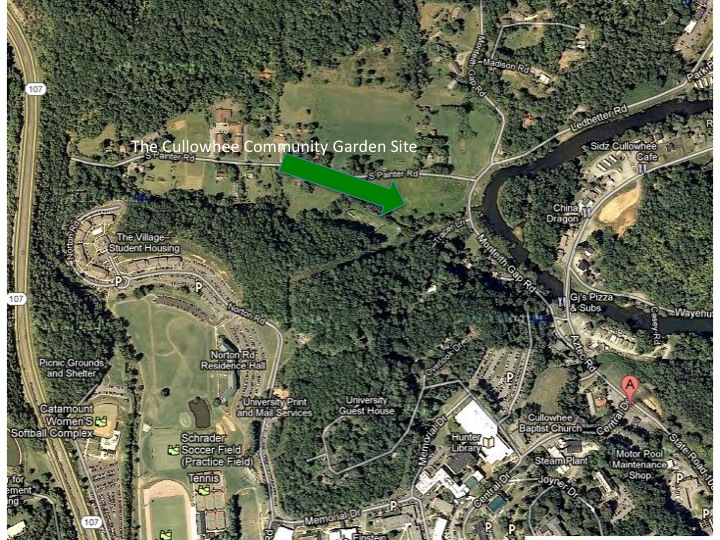
Hey Everybody! In case you've been wondering just where this New Cullowhee Community garden is going to be located, I am posting a couple of photos that will show you where, and show just how close this project will be to the university, and to you.
Here is a Google Maps Image of the garden location in relation to WCU Campus, and Old Cullowhee Rd

And, here is a close-up picture of the garden site. The borders of the property are S Painter rd; Monteith Gap Rd. and Cullowhee Creek. This will be a shared use property with the Jackson County Greenways
More Info To Come...

Wednesday, June 27, 2012

While we are in the planning and design phase for The Cullowhee Community Garden, I thought that I would draw your attention to some of my favorite Community Gardens in the region. these gardens will all serve as models for our project in Cullowhee, and have laid the groundwork for us today. If we succeed, it is because we are standing on the soil of gardens that have come before us.

The first garden to be profiled is The Sylva Community Garden, located on Storybook Ln.  in beautiful downtown Sylva, NC.  The Sylva Community Garden was started, according to volunteer Marsha Crites, in 2006 by a group of Master Gardeners on land in the community once known as "The Pumpkin Patch." Recently we learned more of the history of the land on which we garden, thanks to a recent presentation by long time resident, and former Sylva Mayor, Brenda Oliver. It seems that the land where the garden is located has been gardened for almost a hundred years in some form or another.

When The Sylva Community Garden was first established, it was one big garden run by volunteers, with all produce grown being donated to The Community Table of Sylva. While this was a great endeavor, with many volunteers and people excited to help out in the Spring, by Summertime when it gets hot and buggy there were only a few dedicated volunteers showing up to work the garden. It got a little overwhelming. So, a decision was made to break up the 1/3rd acre garden into individual plots, 15 feet by 30 feet. These plots were then offered to community members to adopt, under the agreement that they would donate produce to those in need.

This model has worked out wonderfully. Each year, the Sylva community Garden has grown bigger and more beautiful. There are now 23 individual plots, all adopted and lovingly cared for with organic and natural methods. In 2010, 800 pounds of produce was donated to The Community Table.  Last year, we donated almost 1100 pounds. That's 1100 pounds of produce grown without synthetic chemicals, and then walked across the street to be used in helping to feed our community. What a great feeling it is to garden in community, and know that your efforts are helping your neighbors in need.

Aerial Photograph of The Sylva Community Garden.          Photo by WCU Center for Shoreline Development
Can't wait to see how this beautiful garden grows in the future. For more information on how you can get involved and help The Sylva Community Garden please contact Jennifer Cooper @ jacooper@email.wcu.edu  or Adam Bigelow @ bigelownc@gmail.com  Or, you can always come join our weekly volunteer workdays, every Wednesday evening starting at 5:00 pm.